Monday, May 12, 2014

Hanging Vase & Tea Bowl by Mike Weber


Mike Weber's new arrivals of his unique hanging vases.
Made from two types of clay, porcelain and stoneware, they are beaufitul sculptures for your wall.
Apart from the rest of Mike's tea bowl, this one has golden accents along the rim with Mike's signature wood fired technique.
This piece is a special addition to any collection.


Hanging Vase
19" x φ1"3/4


Hanging Vase
17" x φ1"3/4


Tea Bowl with Golden Rim
φ4"1/2 x H 3"


Wednesday, May 7, 2014

"Transformations into Bronze" Malcolm Wright Exhibition 5/16 Fri.-18 Sun.

To know more about Malcolm Wright and his works, we would like to introduce his writing regarding his sculpture and bronze sculpture.

" Heart Muscle "  Brick Clay

" Heart Muscle "  Bronze

SCULPTURE
This body of work has evolved over the last 20 years.
Originally it was all glazed stoneware and intended for flower arranging. Over time it has become unglazed, and most often made from brick clay. I am inspired by the work of Chuck Ginnever, Tony Smith, the Constructivists and Futurists, among others.
These pieces are made from extruded parts that are cut apart, altered and reassembled. Sometimes you can see the original extruded and shape and sometimes not at all.
Many pieces work in more than one position there is usually more than one "right side up."

This method is slow and deliberate. A single piece can take days, a week or a month and then crack or break in the drying or firing.
The results depend on the vagaries of the firing for color and texture.
After weeks or months of handbuilding the changeover to working on the wheel feels fluid, quick and quite free.
I find that moving back and forth between these techniques is very rewarding.


" Two Sides "  Brick Clay

" Two Sides "  Bronz
BRONZE SCULPTURE
The bronze sculpture project started in 2007 when my friend Jay Lindsay, of Carmel NY, wrote me that he had bought 800 pounds of bronze ingot. I knew immediately what to do with some of that ingot. As early as 2001 I made some small maquettes of clay sculptures that would translate readily to larger bronze forms. I have kept those forms for future reference, and with Jay's significant help, ten of these forms have been cast in bronze. Some have been enlarged to a scale of from 15 to 26 inches. Some have been cast in the original scale of five to eight inches.

So why am I interested in bronze? When I began working in clay sculpture, the first pieces were glazed and rather shiny. I was then drawn to working with the dark, porous- appearing, rather dry, wood-fired brick clay. The bronze surface is somewhere in between, cool and hard, but not reflective.

Bronze carries a feeling of permanence. When I arrive at a form that, to my eye, appears mature, I have a desire to see it realized in bronze. Bronze leads to the possibility of small editions, and varied surface treatments. Color is variable and controllable. Finally and most important, the visual hardness of the material works for my forms.


- quoted from " http://theturnpikeroad.com/ "

* Open Hour *
May 16th, Fri.  10 am - 8 pm   Opening Reception  6pm - 8pm
May 17th, Sat. 12 pm - 6 pm
May 18th, Sun. 12 pm - 6 pm

* After the 3 days exhibition, the works will move to our private gallery space "Sara Home".
Please feel free to contact us to see his works.


Saturday, May 3, 2014

Flower Gift Cards by Arline Rubin


Beautiful pressed flower cards are by Arline Rubin.
She uses recycled papers and reclaim printer discards, file folders, gift and store boxes, product packaging and other reuseables.
She recycles flowers and leaves from her own and friends' homes and gardens.
Many people give her cards yet another life by framing them.


Large
Small

There are two different size, each card comes with an envelope. Large : 5"3/4 x 4"1/2  $9.50 each
Small : 4"1/4 x 2"1/2  $5 each
 
Small
Large


Monday, April 28, 2014

Spouted Bowls by Kazu Oba


" Katakuchi " is a spouted bowl, it is often used to pour Sake or dressing like Ponzu sauce.
Some times you can serve food as a regular bowl, or you can arrange flowers.
It is very common in Japan that people find other ways to use the pottery, it brings you a little enjoyment in the ordinary life.
Especially "Katakuchi" has comical shape, it always becomes the best supporting role on the table.
Please take a look "Katakuchi" by Kazu Oba, we have beautiful selections.

It looks like smiling mark, this is Kazu's signature.
One of Kanji character "仁” from his name Kazuhito "一仁" is simplified and became a happy face.


Thursday, April 24, 2014

Gen Saratani Kintsugi Class -The way of Japanese Ceramic Restoration-


Lacquer artist, Gen Saratani, has started "Kintsugi Class"(Japanese ceramic restoration class).
If you are interested in, take a look the information and contact to kintsugi_class@icloud.com.
It must be a precious experience!


Kintsugi Class
- The way of Japanese ceramic restoration -
  
Teacher
Gen Saratani / Japanese Lacquer Restorer and Artist

Class Description

  • Level : Beginner
  • Size : minimum 3 to maximum 5 students
We will study how to restore damaged ceramics with traditional Japanese techniques that use Japanese lacquer (Urushi) and real gold. For the beginner’s class, students will start with a small chipped, cracked or scratched ceramic piece. In 3 or 4 classes, your work will be completed.

Schedule

  • Wednesday classes from 2:00pm to 4:00pm
  • Saturday classes from 10:00am to 12:00pm
Enrollment
kintsugi_class@icloud.com
Please send an E-mail to this address with your information. (which class you want, your name, address and phone number)

Place
Globus Chashitsu Keisuian「憩翠庵」
  - 3min. walk from Union Square
  - 5min. walk from Madison Square Park

Price
$150 (includes all materials required for your completed project)
  -If the restoration area is large, you will be charged an additional fee for the gold (at market price).

What to Bring
Ceramic piece with small chip, crack or scratch

Dress Code
Long sleeves (there is a possibility you will get dirty)
  -We provide gloves and arm covers. If you have something to cover your arms, please bring them.

Notice

  • We use real Japanese lacquer (Urushi) and pure gold in order to get the authentic experience.
  • In some cases, it is possible to develop a rash if the lacquer comes in direct contact with your skin. We provide groves and guidance for properly handling the lacquer. (Please read below, “Why can Urushi cause a rash?” )
  • If the lacquer gets on your clothes, it cannot be removed.  It does not come out even if you wash it. We strongly recommend that you cover your arms and legs and to wear a long sleeve shirt that can become dirty.
  • Please be sure to arrive on time.  The lesson will begin promptly at the beginning of each class.

“Why can Urushi cause a rash?”
Urushi (Japanese lacquer) comes from a plant that is related to poison ivy. Urushi, in its liquid form, can cause an allergic rash and dermatitis when it comes in direct contact with your skin. The occurrence of Urushi rash is more likely if you also have an allergic reaction to mango. Fully dried Urushi cannot cause a rash.  The rash normally appears 24 hours after contact and clears up within 2 weeks. Symptoms include itching and blistering.  The duration of the rash and severity depends on the person’s level of immunity.  Do not scratch the rash in order to prevent any scarring. Because Urushi is not commonly used in the United States, we do not suggest using any creams or medicines to treat the Urushi rash as long as the rash area is controlled and does not significantly worsen. Using medicines may cause further discomfort or exacerbate the rash.

General Disclaimer

  • We are not responsible for the Urushi rash, dirty clothes, and any injury or accident in the facilities.
  • We will store the ceramics for the duration of the class, but are not be liable in case of a theft, fire, or other emergency on the premise.
  • No refunds except when lessons cannot be held. 
Before
After
Before
After
Before
After

Tuesday, April 22, 2014

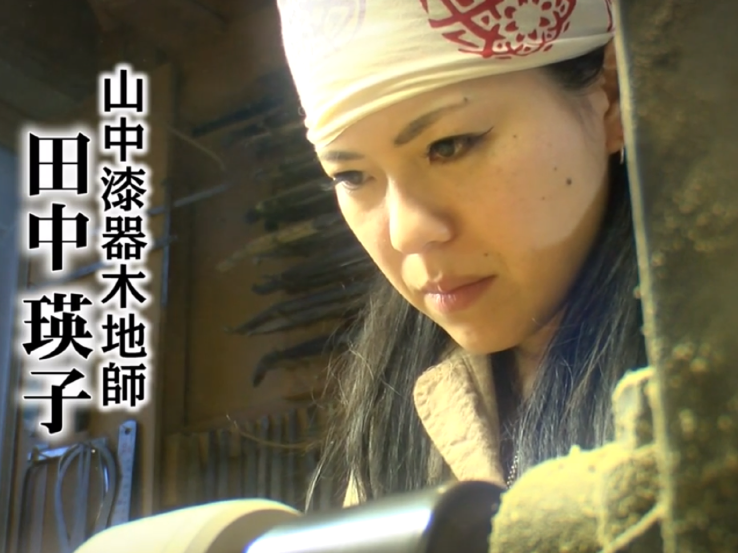
Eiko Tanaka in on Japanese TV program "Au eno Tobira" on Discovery Channel

http://www.athome.co.jp/tobira/56/

Eiko Tanaka has had an interview for Japanese TV program called "Asu eno Tobira(明日への扉)” on Discovery channel.
You can check the video from HERE.
This TV program will be on air in the international ANA airline (All Nippon Airways).
Although it is played in Japanese, you will be able to see how she works.

Lacquer Cups and Bowl by Eiko Tanaka


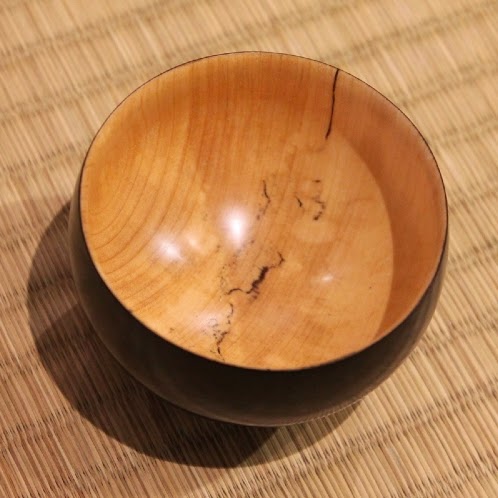
New arrivals from Eiko Tanaka, who is a skillful wood-turner and a lacquer artist.
We got sake cups, small dishes and small bowls for this time.
Beautiful wood grain is showed up through the lacquer.
Please come and take a look, the pieces are limited.


Bowl - Spalted Wood
φ5"3/4 x H4"

Soup Bowls - Spalted Wood
φ4" x H3"

Hinoki Sake Cups
φ2"3/4 x H2"

Hinoki Sake Cups
φ2"3/4 x H2"


Sake Cups -Spalted Wood
φ2"3/4 x H2"


Sake Cups -Spalted Wood
φ2"3/4 x H2"

Small Dish - Spalted Wood
φ3"5/8 x H1/2"

Small Bowl
φ 3"1/2 x H 2"1/2